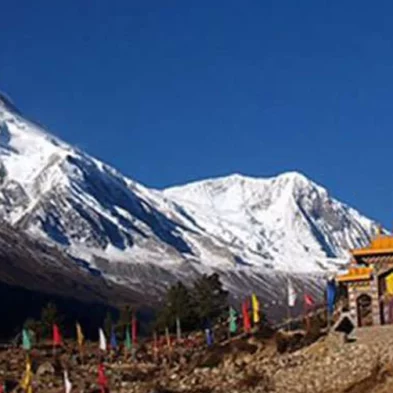


Manaslu Circuit Trek- 14 Days


14 Days
Trip Duration
Difficulty
Moderate
Activities
Trekking
Group Size
Min 2 People
Max. Altitude
5106m./16752ft.
Destination
Nepal
Meals
- 14 Breakfast
- 11 Lunch
- 11 Dinner

Accommodation
- 3-star hotel in Kathmandu
- Guesthouse during trekking

Transportation
- Private Vehicle

Highlights of Manaslu Circuit Trek- 14 Days
- Less-trodden path, full of pristine landscapes away and rich cultural immersion
- Awe-inspiring scenes of Mt. Manaslu- eight highest peak in the world along with glorious Boudha Himal, Cheo Himal, and many more
- Explore one of the virgin protected areas of Nepal, the Manaslu Conservation Area.
- The beautiful Budhi Gandhaki River accompanies the trek, enhancing the scenic experience.
- Trek while enjoying the stunning mountain views of Ganesh Himal and Shringi Himal.
- Experience the unique blend of Tibetan and Nepalese culture while visiting rural villages of Samdo, Samagoan, Dharamshala and many more
- Challenge yourself by opting for ascent of Larkya La Pass at 5106 m and marvel at the all-encompassing visuals of the Himalayas
- Visit ancient monasteries, and gain an insight on the religious element of the trail

Need help? Talk to travel expert
Trip Overview of Manaslu Circuit Trek- 14 Days
Manaslu Circuit Trek is used to be Nepal’s hidden treasure, but nowadays it is surging in popularity amongst admirers of nature and adventure. It is a beautiful walk that unfolds rugged beauty and cultural richness, weaving its way through the heart of the Himalayas. This is an off-the-beaten-path adventure that promises breathtaking landscapes and profound cultural insights.
Despite increasing attention, Manaslu Circuit Trek still manages its visitors to offer solace in nature. The trail winds through charming parishes, terraced fields, and lush woods offering an authentic and unspoiled experience. As you navigate this less-walked path, trekkers can feel the tranquility and serenity of Mother Nature.
It is a moderately challenging journey, yet its rewards are more worthwhile than physical challenges. Being prepared for the journey in terms of health aspects can be arduous, but prior preparation will turn out to be worth it when you get to enjoy the untamed and undisturbed beauty of mother nature.
The trek might be a physical journey, but it equally is also a cultural immersion. Trekkers on this journey get to enjoy the warmth of the diverse ethnic communities that reside in these areas. Mostly habituated by Gurung and Tibetan communities, you can take a glimpse into the day-to-day life on the trail. Samagaon, Samdo, and Dharamshala are a few of the notable villages you pass on this journey that present a unique blend of Nepalese and Tibetan cultures. These villages laid in the shadows of mighty Himalayas showcase rich cultural heritage and a chance to feel the essence of their spiritual practices.
With significant cultural exposure, adventure awaits at Dharamshala, or Larkya Phedi for travelers. Crossing the exuberating Larkya La pass (5106 m) can be testing, but the panoramic views of snow-clad peaks, sprawling glaciers, and the raw beauty of the surrounding landscape from its summit are simply worthwhile. Another thrilling addition to this journey is Birendra Taal, a pristine alpine lake on the trail. The lake mirrors the majestic peaks that surround the tranquil lake amidst the massive Manaslu range.
The journey thrives on its off-the-beaten-path allure and the adventure that transcends the ordinary. So, do join Hike Holiday Trek to discover this transcending beauty and relish the beauty of a trail less taken. For any more queries about the journey, feel free to contact us! Our experts are more than happy to assist you!
Detail Itinerary of Manaslu Circuit Trek- 14 Days
Day 1: Arrival at Tribhuwan International Airport in Kathmandu
Upon your arrival in Kathmandu, one of our representatives will warmly welcome you at the airport and then transfer you to your designated hotel. After taking some rest and freshening up, we will head towards the center of Kathmandu city, where you will explore the lively streets of Thamel. Here, you can make minute preparations for your trekking adventure. Later, we will return to the hotel for a comfortable overnight stay and prepare for tomorrow’s journey.
Activity & Duration
30 mintues driveHighest Altitude
1335m. (Kathmandu)Meals
Breakfast includedAccommodation
3-star hotelDay 2: Drive to Machha Khola (900m/2952ft): Distance: 160 Km, Duration: 8-9 Hours
You’ll drive early morning from Kathmandu to Soti Khola, taking around 7-8 hours on the Prithvi Highway alongside the Trishuli River. During the travel, you’ll see Nepal’s diverse landscapes, from bustling cities to rural villages, terraced fields, rivers, and majestic peaks. Along the way, you will Pass through Arughat – a small Gorkha community, and reach Gola Bhanjyang.
The drive to Soti Khola can be bumpy and dusty but equally scenic; upon reaching Soti Khola, the gateway to the Manaslu trek, you’ll rest and have lunch for a while. However, you won’t stop here and will continue driving for another 1.5-2 hours along the Budhi Gandaki River trail. You will reach Machha Khola at an altitude of 700m. you’ll spend your first night in the trek region at Machha Khola.
Activity & Duration
8-9 hours driveHighest Altitude
900m. (Machha Khola)Meals
Breakfast, Lunch and Dinner includedAccommodation
Overnight at GuesthouseDay 3: Machha Khola to Jagat (1340m/4395ft); Walking Distance: 22 Km, Duration: 6-7 Hours
Today’s trek will take you further along the Budhi Gandaki River, crossing it Multiple times via suspension Brigdes. You will gently climb to Khola Bensi by crossing Machhe Khola via suspension bridges. Following the trail, you’ll pass through picturesque villages such as Tatopani, where you can soak in the natural hot springs, and Doban, known for its Scenic beauty and traditional architecture.
As you ascend, the landscape becomes more rugged, with towering cliffs and rocky outcrops dominating the scenery. About a 6-7-hour hike from Machhe Khola, you will arrive at Jagat, a charming village situated at the crossroad of several trekking routes with traditional stone houses and prayer wheels adorning the streets that offer a glimpse into rural Nepalese life. You’ll spend your night at Jagat.
Activity & Duration
6-7 hours hikeHighest Altitude
1340m. (Jagat)Meals
Breakfast, Lunch and Dinner includedAccommodation
Overnight at GuesthouseDay 4: Jagat to Deng (2095m/6871ft); Walking Distance :20km ,Duration: 8-9 Hours
After leaving Jagat, you’ll enter the Manaslu Conservation Area, which is famous for its diverse flora and fauna. The path will take you along the eastern bank of the Budhi Gandaki River, passing through a dense forest of rhododendrons, oaks, and pines. You’ll cross several suspension bridges and rocky outcrops, giving you a thrilling view of the river below. Crossing on the long suspension bridge along the way and climbing steeply, you’ll reach Philim, a traditional Gurung village. You’ll also pass through the settlement of Eklebhatti, walking across terraced millet fields and crossing the river twice via suspension bridges. You’ll continue along the banks of the Budhi Gandaki River and then through bamboo forests until you reach the Deng Khola River. You’ll cross this river to reach Deng, your destination for the day.
Activity & Duration
8-9 hours hikeHighest Altitude
2095m. (Deng)Meals
Breakfast, Lunch and Dinner includedAccommodation
Overnight at GuesthouseDay 5: Deng to Namrung(2900m/9512ft): Walking distance: 19.5km, Duration: 7-8 Hours
Today’s trek takes you deeper into the Manaslu Region, offering breathtaking views of snow-capped peaks and alpine meadows on the way to Namrung. The route takes you through Bihi Phedi and Bihi, with a short descent and a sharp ascent leading to Rana Bridge. After crossing the bridge, you will reach Bihi Phedi and cross another suspension bridge to Ghap. You need to go across Budi Gandaki many times and will also pass by small monasteries.
Keep an eye out for Himalayan wildlife, such as blue sheep, Himalayan marmots, and even the elusive snow leopard inhabiting the rocky slopes and cliffs. Then, the trail descends above the river as you trek alongside the north bank. After crossing the river and walking alongside the banks, you will arrive at Namrung(2630m) – a Tibetan-influenced village surrounded by prayer flags and shortens, the gateway to Upper Nupri. You spend the night here.
Activity & Duration
7-8 hours hikeHighest Altitude
2900m. (Namrung)Meals
Breakfast, Lunch and Dinner includedAccommodation
Overnight at GuesthouseDay 6: Namrung to Lho gaun(3180m/10430ft); Walking Distance : 8.1km, Duration 4-5 Hours
Today’s trek will take you to Lho, a culturally rich village adorned with prayer flags, Mani walls, Chortens, and other stupas. You will enter the beautiful Lihi village through the plateau of Bhanzam with barley fields and stone houses. After crossing the Hinang River, you will finally reach Lho. Along the way, you can enjoy majestic views of snow-capped mountains, including Peak 29 and Mount Manaslu. Additionally, you will take a side tour of Gompas, an age-old monastery. Following the side tour, you will spend the night in Lho.
Activity & Duration
4-5 hours hikeHighest Altitude
3180m. (Lho Gaun)Meals
Breakfast, Lunch and Dinner includedAccommodation
Overnight at GuesthouseDay 7: Lho Gaun to Samagaon (3520m/11550ft); Walking Distance: 8.1 Km, Duration: 4-5 Hours
After leaving Lho, you will make your way towards Samagoan, ascending through alpine forests and pastures towards the base of Manaslu. Along the way, you will follow the Pungyen glacier. As you hike with a visit to the Ribung Gompa and then head up through a pine and rhododendron forest, you will eventually come upon Shyala village. The village is surrounded by agricultural fields and has several wooden resting places. After crossing a small stream draining the Pungyen glacier, you will finally reach Samagoan, the largest village on the Manaslu circuit and the closest to Manaslu Base Camp, where you will be spending the night.
Activity & Duration
4-5 hours hikeHighest Altitude
3520m. (Samagaon)Meals
Breakfast, Lunch and Dinner includedAccommodation
Overnight at GuesthouseDay 8: Acclimatization Day at Samagaun
Today, you’ll Spend a rest day in Samagoan to acclimatize to the altitude and explore the surrounding area. You can take three side trips: a full-day hike to Manaslu Base Camp (4750m), 7-8 hours walk from Samagaun, or a hike up to Birendra tal (a glacial lake at the base of Manaslu glacier), which is the starting point for the trail to Manaslu Base Camp or hike to Pung Gyan Gompa lies in the south of Samagaon. Alternatively, you can immerse yourself in the local culture by interacting with villagers and participating in traditional activities.
Activity & Duration
7-8 hours hikeHighest Altitude
4750m. (Manaslu Base Camp)Meals
Breakfast, Lunch and Dinner includedAccommodation
Overnight at GuesthouseDay 9: Trek to Samdo (3875m/1270ft) ; Walking Distance : 11.5 Km,Duration : 4-5 Hours
After leaving Samagoan, the trail ascends towards Samdo village. As you ascend the trail, you’ll pass through an extensive valley with extended mani partitions, high-altitude meadows, and yak herding encampments. Be sure to watch for Himalayan wildlife and various bird species, including the Himalayan Monal. The trail heads north, passing through juniper and birch forests, and descends to Budhi Gandaki, where you’ll cross a wooden bridge over the river and climb steeply across it. After passing the starting point of the Buddhi Gandaki River, you’ll enter Samdo village.
Samdo is a Tibetan refugee village located near the Tibetan border, offering a unique cultural experience as it is home to several accident monasteries and gompas where you can learn about Tibetan Buddhism. At Samdo, you’ll get fantastic views of mountains, especially Manaslu, and spend the night there.
Activity & Duration
4-5 hours hikeHighest Altitude
3875m. (Samdo)Meals
Breakfast, Lunch and Dinner includedAccommodation
Overnight at GuesthouseDay 10: Samdo to Dharmasala (4460m/14630ft) ; Walking Distance : 8.00km, Duration : 4-5 hours
Today, as you ascend towards Dharamsala, you’ll embark on a leisurely walk across the Budhi Gandaki River. You’ll encounter the fascinating Mani walls adorned with carved prayers along the way. This trail will lead you to the Larkya bazaar and grassy slopes to Syacha Khola Valley . Keep an eye out for the rare snow leopards, Himalayan blue sheep, and musk deer that might cross your path. As you cross the Athhara Saya Khola and follow along the Larke Khola, you’ll be greeted by the sight of the Mani walls and prayer flags, clearly indicating the Larkya La Pass’s proximity. Your path will then take you through juniper woods and tundra vegetation, offering a picturesque view of the Larkya La Glacier from a scenic viewpoint. After a steady climb, you’ll reach Dharamsala/Larkya La Phedi, which promises the most breathtaking views of snow-capped mountains, including the majestic Larke and Naike peaks. This is where you’ll spend the night.
Activity & Duration
4-5 hoursHighest Altitude
4460m. (Dharmasala)Meals
Breakfast, Lunch and Dinner includedAccommodation
Overnight at GuesthouseDay 11: Dharmasala to Bhimtang (3590m/11750ft) via Larkya La Pass (5,106m/16750ft); Walking Distance: 24.5 Km, Duration: 8-9 Hours
Starting early in the morning, today will be the most exciting and important day of the whole trek as you ascend to the Larkya la Pass (5,100m), which is the highest point of the journey. You will gradually climb uphill and pass through the valley to arrive at the frozen lakes. Then, you will carefully descend to four frozen lakes and ascend the massive lateral moraine of the glacier, which becomes quite steep just before reaching Larkya la Pass. Once you reach the summit of the Larkya La Pass, you’ll be rewarded with panoramic views of Himlung Himal (7126 M) near Tibet, Kang Guru (6981 M), Annapurna II (7937 m) range, and other peaks.
Take some time to rest and soak in the breathtaking scenery before beginning the descent. As you descend, the landscape gradually changes from barren alpine terrain to lush forests and meadows. You’ll pass by glacial lakes and snowfields, adding to the beauty of the scenery. After 3-4 hours of descent, you’ll arrive at Bimthang, a picturesque valley surrounded by towering peaks. Here, you’ll find a comfortable lodge where you can rest, enjoy a warm meal, and reflect on the day’s journey.
Activity & Duration
8-9 hours hikeHighest Altitude
5106m. (Larke Pass)Meals
Breakfast, Lunch and Dinner includedAccommodation
Overnight at GuesthouseDay 12: Bhimtang to Goa (2515m/8250 Ft); Walking Distance: 19 Km, Duration:6-7Hours
Today, you will start your journey from Bhimthang after having breakfast and resting. After walking for 25 minutes, you will reach the Kechakyu Khola glacier. As you move downwards towards the Budhi Gandaki River, you will have to cross it to reach the rhododendron forest, which will then lead you to Karche, a cultivated area near the top of the Budhi Gandaki valley. The stunning view of Mt. Manaslu can be seen from here as well. The trail will continue along the riverbank and eventually lead you upwards to the Gurung village of Gho, where you can spend the night.
Activity & Duration
6-7 hours hikeHighest Altitude
2515m. (Goa)Meals
Breakfast, Lunch and Dinner includedAccommodation
Overnight at GuesthouseDay 13: Trek to Tilije (2300m) (1.5 Hours Walk) and Drive to Kathmandu. Distance: 215Km, Duration: 10Hours
Today’s trek will take you through a variety of breathtaking landscapes as you descend towards the village of Tilije. The trail winds its way through stunning rhododendron forests, alpine meadows, and cascading waterfalls, offering you some of the most beautiful views of the surrounding mountains. Along the way, you’ll pass through quaint villages and terraced fields, where local farmers cultivate crops such as potatoes, barley, and buckwheat. Once you arrive at Tilje, a large Gurung settlement, famous for its brandy you can take a break and enjoy.
After resting for some time, we will head towards Dharapani then to Besisahar, and finally, to Kathmandu via private or public jeep. As you might arrive in Kathmandu late at night, you can relax for the night in a hotel in Kathmandu
Activity & Duration
1.5 hours hike and 10 hours driveHighest Altitude
2300m. (Tilije)Meals
Breakfast, Lunch and Dinner includedAccommodation
Overnight at 3-star hotelDay 14: Tour Ends/Departure
We will bid you farewell at Tribhuvan International Airport and welcome you to visit us again. We hope you have a wonderful experience with us.
Activity & Duration
30 mintues driveHighest Altitude
1335m. (Kathmandu)Meals
Breakfast includedIncludes and Excludes
What is included?
- All ground transportation by private vehicle, including airport transfers.
- Two nights’ accommodation with breakfast at a 3-star category hotel in Kathmandu.
- Full board meals with tea/coffee (breakfast, lunch, and dinner) during the trek.
- Best available twin-sharing lodge-to-lodge accommodation during the trek.
- One highly experienced, helpful, and friendly guide and one porter (1 porter for 2 people), along with their food, accommodation, salary, equipment, and accidental insurance for all staff.
- Manaslu Circuit trekking special permit fee (Manaslu region is in a restricted zone, requiring a special permit to visit this area).
- TIMS Fee – Trekkers’ Information Management System (Please bring 2 passport-size photos for the permit).
- Annapurna and Manaslu conservation fees.
- First aid medical kit with the provision of an Oximeter to monitor oxygen level and heartbeat.
- Government taxes and office service charges.
What is excluded?
- Meals not specified in the ‘Meal Inclusions’ in the itinerary.
- Travel Insurance.
- International airfare.
- Nepal entry visa.
- Drinks such as Coke, Fanta, juice, water, etc.
- Snacks and other personal expenses.
- Hot shower during the trek.
- Personal trekking equipment.
- Tips and gratuities for trekking staff and drivers.
Trip Information
Best Time
The best time to trek over the trail of Manaslu Circuit Trek depends upon your personal choice. It is not possible to pick any specific time as the best time as it is more of a personal interest and the features which you want in your trekking journey. So, by considering the choice and the features most of trekkers and travelers, the season of spring and the season of autumn are said to be the best seasons for this trek. This season offers diverse features as well as the best advantages to the trekkers.
In spring, all the flowering wildflowers will be blooming at the trail giving a very scenic walk throughout the route. The days will be longer, which gives you the chance to spend more time there. As well the weather will also be in a stable condition. The visibility will be clearer as the pre-monsoon rain washes all the dust in the air and provides the refreshing tranquility of the Himalayas. So, during Spring, the trail gets scenic, and a refreshing journey will be a great advantage.
And during Autumn, the trail gets very colorful, due to the changing phase of dry leaves. And the warm hue also adds more flavor to the journey. You will get the most stable weather of the year, and the most cleare4st visibility to enjoy the magnificent views and scenery of the Manaslu region. It makes the journey more mesmerizing after it gets the wind of the Himalayas. So, during the Autumn, the journey will get more mesmerizing and a scenic one to do trek in Manaslu Circuit Trek
Permits
You will need to get some permits to get access inside the Manaslu region as it is a protected area by the government of Nepal. You should take them from the government representative offices or the tourism board. All should be filled with the legal information of the issued person. Below are the permits to get before the Manaslu Circuit Trek.
- TIMS (Trekking Information Management System)
- MCAP( Manaslu Conservation Area Permits)
- ACAP(Annapurna Conservation Area Permits)
- MRAP(Manaslu Restricted Area Permits)
Accommodation of Food And Drinks
The accommodation for this trek of Manaslu Circuit Trek comes with the basic logistics. The services that are needed in a basic form are all covered by this package. The meal comes with the structure of Breakfast Meal and Dinner. All the stays are managed with the proper guesthouses. All the basic logistics will be covered.
The menu for foods will be more concentrated with the local foods which consist of Dal Bhat Tarkari, momo, chow mein, eggs, and other varieties of items. All of them are provided with the planned schedule. You will not that often get any of your favorite Western dishes as Manaslu is still a new trail in the trekking world and there are no such restaurants that provide services related to Western dishes.
The external expenses related to any kind of food drinks and beverages will be excluded or do not come inside the package. It includes services like sweets, desserts, ice cream, beverages, bars, etc. For more details, check the cost section or the exclude section.
Do compromise with the basic services provided to the lodges there in the Manaslu Circuit Trek as they all run with limited resources. All the goods are transported with the help of animals as there are no means of road transport there. So, they are unable to provide you with standard services like what you get inside the Kathmandu Valley.
Also, the prices of products and goods can be found more expensive than their marked price, so we recommend you not to get into arguments with locals as they also have very limited opportunity to earn some money and you know all the goods are taken by humans and animals.
The overnight stays will be all managed at the guesthouses during your travel.
Preparation and Fitness
As we talked about above, this trekking of Manaslu Circuit Trek is a very diverse journey as well as more remote. So, you need to have prepared for the journey itinerary of about 21 days. So, it is not only heeded, it is necessary to stick with a proper plan and preparation before the trek.
Always prepare with the clothing as you are going to have a long journey over the remote part of Nepal. You may need more clothing than you think. So plan properly and carry as much as you think can hold you for a whole journey. But do not carry unnecessary amount clothing or any of the essentials as it may increase the weight of the backpacks and the essentials which can ruin your trekking experience.
Carry all the materials that you will need personally such as trekking poles, water bottles, electric appliances, and what you think you need the most during your journey.
Carry the first aid kid with some of the basic medical support materials as the Manaslu Circuit Trek is a diverse and remote trek that carries the possibilities of unfortunate accidents, and in such cases, basic medical support can be a great help.
You need to be in good shape to do this trek as it covers proper mountain geography and ascending and descending terrains over cliffs. So, it is a necessary requirement for your personal experience to be in good shape to do this trek properly.
For better fitness during your journey, you can do some basic physical and breathing exercises about a month before the itinerary for best results.
All of the above should be taken with the government-issued stamps and the legal information filled in. Otherwise entering inside the premises of the national park without the permits is considered to be an illegal act and can be taken under the legal actions according to the circumstances.
Frequently Asked Questions
Which is better, the Manaslu Circuit Trek or the Manaslu Circuit Trek with Tsum Valley?
Manaslu Trek with Tsum Valley provides profound value to the trek. It takes you to the natural wonders of the Himalayas and explores the region’s spiritualism. It is better for those with extended time and desire to explore cultural insights deeply.
The Manaslu Circuit trek is a better option for those who have limited time and are interested in standard trekking. It focuses more on the adventure and the natural beauty of Manaslu.
How can I charge my devices?
You will get access to electricity during your stay in guesthouses as well you can carry a power bank if you prefer to be more reliant on yourself as there is no certain possibility of wet enough electricity to charge your electric appliances. Also based on seasons, some of the guesthouses can charge some extra amount for charging the electric appliances due to the limited electricity in the region.
What are the permits required for the Manaslu Circuit Trek?
Three permits are required to trek in the Manaslu Tsum Valley Trek:
Manaslu Conservation Area Permit (MCAP).
Annapurna Conservation Area Permit (ACAP).
Special Restricted Area Permit (SRAP).
How can I get internet access through data during the trek and what is the condition of wifi there?
You can buy a SIM card from Ncell or NTC for data packages during your trip. It will offer you a variety of different data packages with different amounts of charges. You only need a photocopy of your passport and a pp-size photo to get the SIM from any seller.
For data packages,
Ncell: *17123#
NTC: *1415#
The WIFI services, it is available during the stay in guesthouses. Remember all the guesthouses may not have a WIFI connection with them and again those who have can charge you some extra amount for the WIFI connection provided to you. It is due to the expensive internet service there and too difficult to manage a proper connection.
What to do if you suffer from altitude sickness?
If you or somebody is suffering from mountain sickness, immediately inform the guide. There are various ways to deal with the situation and they are professional in this regard. Besides consulting with the guide, one can descend to a lower altitude to acclimatize. However, if the condition is worse, it is crucial to evacuate from the location for professional medical attention. There are emergency helicopter rescue services available for such cases and our company will assist trekkers in arranging the service
What documents are necessary to get a Restricted Area Permit?
To get a Restricted Area Permit, you need to submit, your scanned passport size photo, trekking schedule, and a passport number.
Will somebody come to pick me up at the airport upon my arrival?
One of our airport representatives will be at the airport to welcome you. He will be carrying the Hike Holiday Treks placard with your name underneath. He will take you to your hotel and help you to check in.

Trip Reviews on Manaslu Circuit Trek- 14 Days


US$ 1250 for min 3 person
- 1 - 2 personUS$ 1300
- 3 - 6 personUS$ 1250
- 7 - 12 personUS$ 1210
- 13 over 9999 US$ 1180
- Guaranteed Best Prices
- Safe Online Bookings
- Adjustable Booking Dates
- Owner operated company
- Many Years of Experience
US$ 1300
Talk to travel expert  +9779851352528
 +9779851352528